Xenophobic Op-Ed in Local Paper Reflects Hate Site’s Arguments
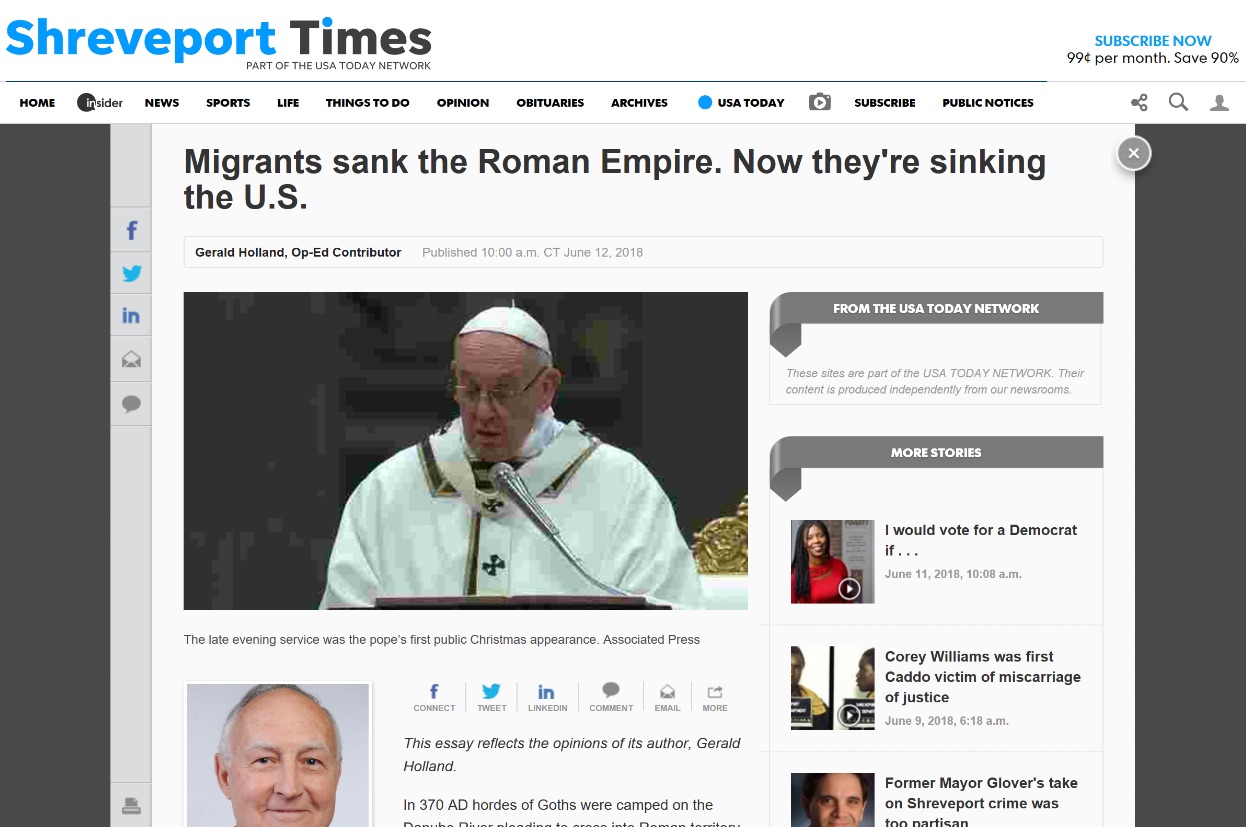
“Migrants Sank the Roman Empire. Now They’re Sinking Us” is the title of a recent op-ed in the Shreveport Times. The article claims that the Roman emperor’s decision to allow Goths seeking protection from the Huns to enter Roman territory in the 4th century CE caused the collapse of the Roman empire, and argues that immigration to the United States and Europe will similarly hasten “the suicide of the West.” Appearing as it does in the primary newspaper of a metropolitan area of half a million residents, this op-ed may seem to represent a mainstream view, but in fact parrots the views of a notorious hate site.
The xenophobia of the op-ed is evident in the way it uses provocative and deceitful descriptions of those attempting to enter the United States to paint them as violent and depraved criminals: refugees and economic migrants are called “uninvited invaders;” Muslim men who are leaving failing states are said to have “abandoned their kin in the killing fields;” and the use of human smugglers by Central American women and children fleeing violence and poverty is described as “Men in Central American countries…trading their women and children.”
The article’s simplistic and reductive understanding of Roman history is, in turn, evident in its assertion that “Today tourists see the results of Rome’s experiment with mass migration. They are called ‘Roman ruins,’” as if the Roman forum (pictured in the op-ed) is in the same condition in 2018 as it was after the Visigoth Alaric attacked the city of Rome in 410 CE. The op-ed’s claim that Roman ruins provide evidence of the threats posed by immigration fits uneasily with the caption under the image of the forum in the piece: “Amazing art and architecture, ancient history, dramatic natural scenery and drool-worthy bites around every turn make Italy a hard-to-resist destination that keeps visitors coming back for more.” Similarly incongruous is the video featuring Pope Francis at the top of the op-ed: Francis has called on world leaders to support “safe, orderly and regulated migration.”
It is shocking to find views like those propagated by a hate site like VDare printed in a mainstream newspaper.
The op-ed proposes an analogy between immigrants coming to America and the Goths of the 4th century CE. This is also a favorite analogy of contributors to VDare.com, a hate site founded by Peter Brimelow, an anti-immigrant activist who is himself an immigrant to the United States. VDare primarily features xenophobic content but has also published material by racists and anti-Semites and is increasingly recognized as a white nationalist organization. It is shocking to find views like those propagated by a hate site like VDare printed in a mainstream newspaper.
Posts on VDare, like the Shreveport Times op-ed, label the Goths “barbarians” as a way of vilifying contemporary refugees (other sites Pharos has documented do the same), suppress the variety of the relationships of the Goths to Roman imperial power over a period of almost 100 years to make it sound like the Gothic forces that killed the emperor Valens in 378 were representative of all Goths as a way of painting all immigrants as threats to the United States, and paint the Roman leaders, who faced a delicate political and humanitarian crisis along with civil unrest on multiple fronts, as self-serving and complacent as a way of demonizing contemporary leaders who favor recognizing the human right of refugees to safety from violence and persecution.
Sites like VDare conflate xenophobic hate with racism against African Americans
Posts on VDare that invoke the Goths in support of xenophobic hate include:
- An article by Patrick Buchanan, who even those on the right recognize is anti-Semitic, nationalist, and an apologist for authoritarian strong-men. He begins his prediction of “the end of America as one nation and one people by the end of mid century” with a reference to the same Goths the Shreveport Times article begins with. Buchanan quotes from a recently published history of the Roman empire recounting how the Goths to whom the Romans gave asylum later revolted and killed the emperor. Buchanan then argues that “we see now…how America ends” as a result of immigration. His article attempts to provoke racist and xenophobic fears by painting immigrants from Mexico as intent on re-conquering California, with a quote declaring “the last gasp of white America in California,” and by saying that diverse populations have made Texas and California “third world states.” Buchanan’s familiarity with the arguments made in the scholarship he cites is questionable, as the quote he begins with appears in a different book than the one he cites. Both are by historian Peter Heather, and it is tempting to suspect that Buchanan wanted to cite the book that had “Barbarians” in its title even if the quote he uses comes from a different book. In any case Heather’s argument is that the fall of Rome should not be attributed to “barbarians” who refused to assimilate (one of Buchanan’s charges against contemporary immigrants), but to Roman imperialism itself, which, as conquered peoples adopted Roman ways (that is, assimilated), produced a shift in the balance of power in the empire.
- A post summarizing Edward Gibbon’s influential 18th century account of the fall of the Roman Empire, written by Steve Sailer, a proponent of racist and pseudo-scientific “Human Biodiversity” (which Pharos has documented previously) who has written that African Americans “possess poorer native judgment than members of better-educated groups.” Sailer implicitly argues that an inclusive citizenship policy will lead to the collapse of America, finding support in Gibbon’s characterization of the Goths for xenophobic assumptions that immigrants seek to undermine American values. Gibbon described the Goths as “barbarians, who are driven by despair and hunger to solicit a settlement on the territories of a civilized nation” and who, unlike Rome’s previous adversaries, would never “acquire the habits of industry and obedience,” whose “manners” would never “be polished by time, education, and the influence of Christianity,” and who would never “insensibly blend with the great body of the Roman people.” The link between Gibbon’s account and contemporary immigration is implicit in the piece’s closing question: “Why can’t we look back on 2015 with the same ironic detachment [as Gibbon did]?”
- A piece expanding on a Breitbart article claiming “The House Armed Services Committee has already passed [legislation] which contained…secretive amnesty for illegal aliens.” Like the Shreveport Times op-ed, the article attributes the fall of Rome to its military’s reliance on non-citizen soldiers in the 4th century CE. The legislation in question gave immigrants with strategically useful language and medical skills a fast track to citizenship if they enlisted.
- A racist review of Charlie LeDuff’s Detroit: An American Autopsy that shows how sites like VDare conflate xenophobic hate with racism against African Americans. VDare distorts LeDuff’s comparisons of Detroit to Rome of the 4th century and the ancient city of Pompeii (destroyed by a volcano in 79 CE), claiming that “although LeDuff never explicitly says it,” race riots in Detroit did as much damage to that city as Mt. Vesuvius did to Pompeii, and that “the Great Migration of blacks from the South to Detroit (like the Huns…which overwhelmed the Roman Empire)…snuffed out white American civilization there.” This quote attributes the fall of Rome to the Huns, not the Goths, but earlier in the post the author attributes that fall to the Vandals and the Goths, thus further illustrating the way such writers suppress differences in circumstances and motivation between different non-Roman peoples just as they suppress such differences between contemporary immigrants.
All links to VDare.com above are to archived images of the site to avoid generating traffic for it, as are our links to the Shreveport Times op-ed. The op-ed itself can be seen here.
