Latin Mottoes in State Flags Sanitize Colonial Violence

Land Acknowledgement: Pharos is researched, written, and published online at Vassar College, an institution situated in the homeland of the Munsee Lenape people. Please read more.
In 2024, the state of Minnesota got a new state flag. It was a meaningful change since state flags encode how a place wants to see itself and its history. The symbolism of the old Minnesota flag celebrated the displacement of Dakota and Ojibwe peoples, who are shown riding away from land now occupied by European colonists, represented by a figure with a plow. That image whitewashes (literally) the history of the state where President Abraham Lincoln ordered thirty-eight Dakota to be hanged in the largest mass execution in United States History. Minnesota wasn’t alone in having a flag that sanitized or celebrated its violent past: although Mississippi abandoned a flag that celebrated the Confederacy in 2020, several state flags still contain Confederate symbols. However, these are only the most obvious examples of flags with hateful symbolism. In a nation with so much colonial violence in its history, all flags should be subject to such scrutiny. This includes the many state flags that feature Latin text.

Massachusetts is one of several states that has considered changing its flag. The current design portrays a Native American in its central field; above, a disembodied arm holds a sword, as if to swing it against the Indigenous person below. The Latin motto on the flag (Ense Petit Placidam, Sub Libertate Quietem) is conventionally translated “By the Sword We Seek Peace, But Peace Only Under Liberty.” This motto, in combination with the imagery of the flag, suggests that “peace” in Massachusetts was achieved by killing the Native peoples who had resided there for more than ten thousand years before the arrival of Europeans. A commission tasked with changing the flag agreed that a new design should be chosen but was unable to select one.
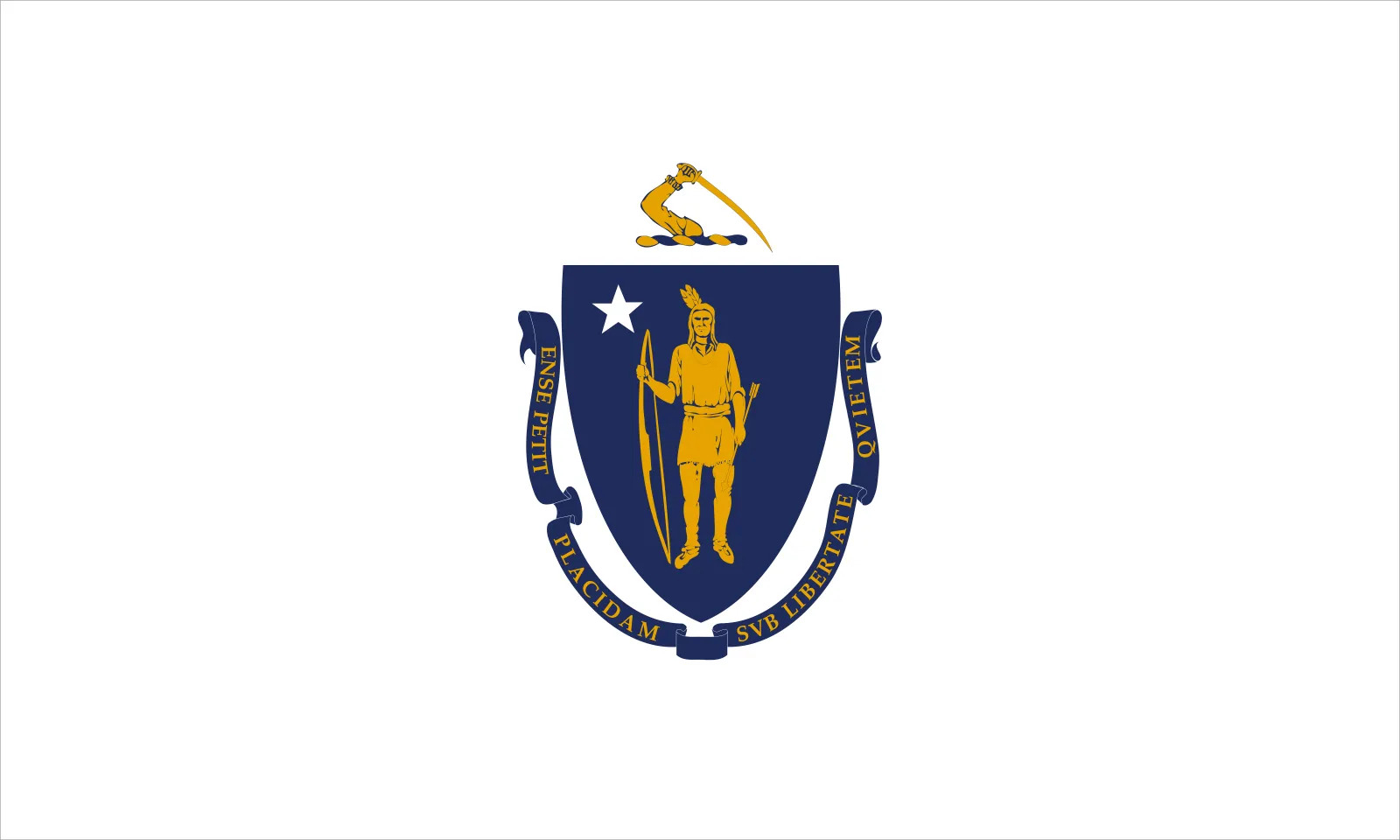
Such a flag celebrates and justifies violence against indigenous people at the government buildings, public schools, and businesses where it is flown. Symbols like this are a prime example of “banal nationalism,” the omnipresent and unrecognized symbols that reproduce a nation’s identity and self-understanding. They serve to reassure citizens that everything is as it should be, that they do not need to think about — let alone attempt to repair — the violence that was, and continues to be, necessary to establish and maintain their state or nation. It’s a lot easier not to. This is why Republicans in the Minnesota House of Representatives have proposed a bill allowing what they call the “historic state flag” — the one that features Native Americans being forced off their land — to continue to be flow in the state, and why one municipality’s city council decided that they’d rather have no flag at all than have to fly the new one.
Should we really be treating these mottoes as an opportunity to build our resumés, when such mottoes justify violence against native peoples?
The violence of such symbolism goes unnoticed partly because those symbols are so familiar, but also because such symbols are designed to idealize that violence. The Latin mottoes that appear on state flags like that of Massachusetts are integral to this idealization of violence. It’s not just that many people cannot understand the language. The symbolic associations of the Latin language — with grandeur, dignity, “serious” politics — obscure the violence of the flag.
Yet many people who do know Latin take pride in its presence in so many state flags. They cite it as a reason to learn the language, alongside other old favorites such as “improving your standardized test scores” and “making it easier to learn other Romance languages.” One site even promises that being able to understand Latin in mottoes such as those on state flags will confer “supreme bragging rights among your friends.” Should we really be treating these mottoes as an opportunity to build our resumés, when such mottoes make violence against native peoples seem not only justified, but glorious, especially when modern-day indigenous men and women continue to experience violence at higher rates than other Americans? On the other hand, learning Latin as a tool that can be useful in exposing how such violence is minimized and sanitized: now that might be something to take pride in.
The Massachusetts flag is only the most egregious example of a state symbol in which a Latin motto celebrates the colonial violence that is pervasive in our nation’s history. Most flags do not celebrate this as overtly as the Massachussetts flag does. But those that juxtapose triumphal Latin mottoes with symbols of European colonialism nevertheless encode a message similar to that of Massachusetts’ flag.
Latin mottoes that appear on many flags impart grandeur and prestige to such claims of European superiority
Such symbols include farmers, plows, products of agriculture, miners and mining tools, the anvil, and sailing ships. Although these are not usually regarded as symbols of colonialism, each of them intersects with claims that Europeans made to justify the theft of native lands and displacement of Native peoples from that land. Colonizers claimed that because indigenous agriculture did not look like that practiced in Europe, native peoples had no use for their land or were neglecting it. Farmers, plows, and harvests symbolize this claim, which appears, for example, in the work of Rousseau, who wrote that “the savages of America…were still savage” because “Metallurgy and agriculture…were unknown” to them. Miners, mining tools, and the anvil thus also symbolize European claims to have bestowed “civilization” on the “new” world. Colonizers held native boats in contempt, even spreading a lie that the Indians could not see European ships because they (allegedly) had no concept of sea travel: representations of European-style boats reinforce this belief in native ignorance and complacency.
The Latin mottoes that appear on many flags impart grandeur and prestige to such claims of European superiority. The flag of Idaho features the motto esto perpetua above a miner, cornucopias of agricultural products, and a woman in classical dress. This motto’s wish that the state “be eternal” celebrates European exploitation of the natural resources of a state in which native history has been ignored.
The state flag of Kansas contains similar images of colonization, including a farmer plowing, a steamship, and a train of the covered wagons that brought settlers westward to the same land that the United States government forced Native peoples to vacate. The Kansas state motto, ad astra per aspera, “to the stars through difficulties,” celebrates the labor of the colonizers and ignores the suffering it inflicted. Michigan’s state flag has no fewer than three Latin mottoes on it: the state motto “If you seek a pleasant peninsula, look around you;” the unofficial motto of the United States, “Out of many, one;” and the Latin word Tuebor, meaning “I will defend,” above a figure representing European colonizers, complete with fur hat and rifle. Only a few years before Michigan adopted this flag, a Michigan sheriff and his deputies had burned a native village at the request of a land developer who claimed he owned the land because the residents had failed to pay property taxes. What, we should ask, is being defended? A settler-colonial state created by decades of forced removal of indigenous inhabitants, who are evidently not considered worthy to be among the “many” who comprise the “one” state.

In New York, the state flag shows European ships on the Hudson River flanked by women in classical dress. The state’s Latin motto excelsior, “ever upward,” equates the colonization portrayed in this image with progress. Connecticut’s state flag shows grape vines, a crop imported from Europe for cultivation in North America, with a motto that confers a divine blessing upon the colonists’ use of indigenous land: qui transtulit, sustinet, “[God] who transplanted [the vines, and colonists] will sustain us.” Maine’s flag shows miners with the Latin motto Dirigo, “I lead”; West Virginia’s combines symbols of mining with images of farmers, sheaves of wheat, and a plow above the state’s motto montani semper liberi, “people in the mountains are always free.” This may be true of the colonists who claimed and exploited the resources of that region, but it’s less true for those indigenous people who had lived there previously. Even before colonists arrived in the area, indigenous populations had been devastated by diseases brought from Europe and violence related to the European fur trade.
Even if there are no visual symbols of colonialism on a flag, a Latin motto may still serve to sanitize the colonialist history of the state. There is not a plow, an anvil, or a ship to be seen on the state flag of Missouri, for example, but there is a Latin motto: Salus populi suprema lex esto. It’s a line from Cicero’s treatise On Laws: “the well-being of the people should be the highest law.” This solemn slogan presents an ideal that the history of Missouri cannot be said to illustrate, beginning with its admission to the Union under the “Missouri Compromise.” That legislation allowed slavery to be legal in the state as a concession to pro-slavery legislators, discarding at the outset any pretense to protecting the “well-being” of all the people residing in the state.
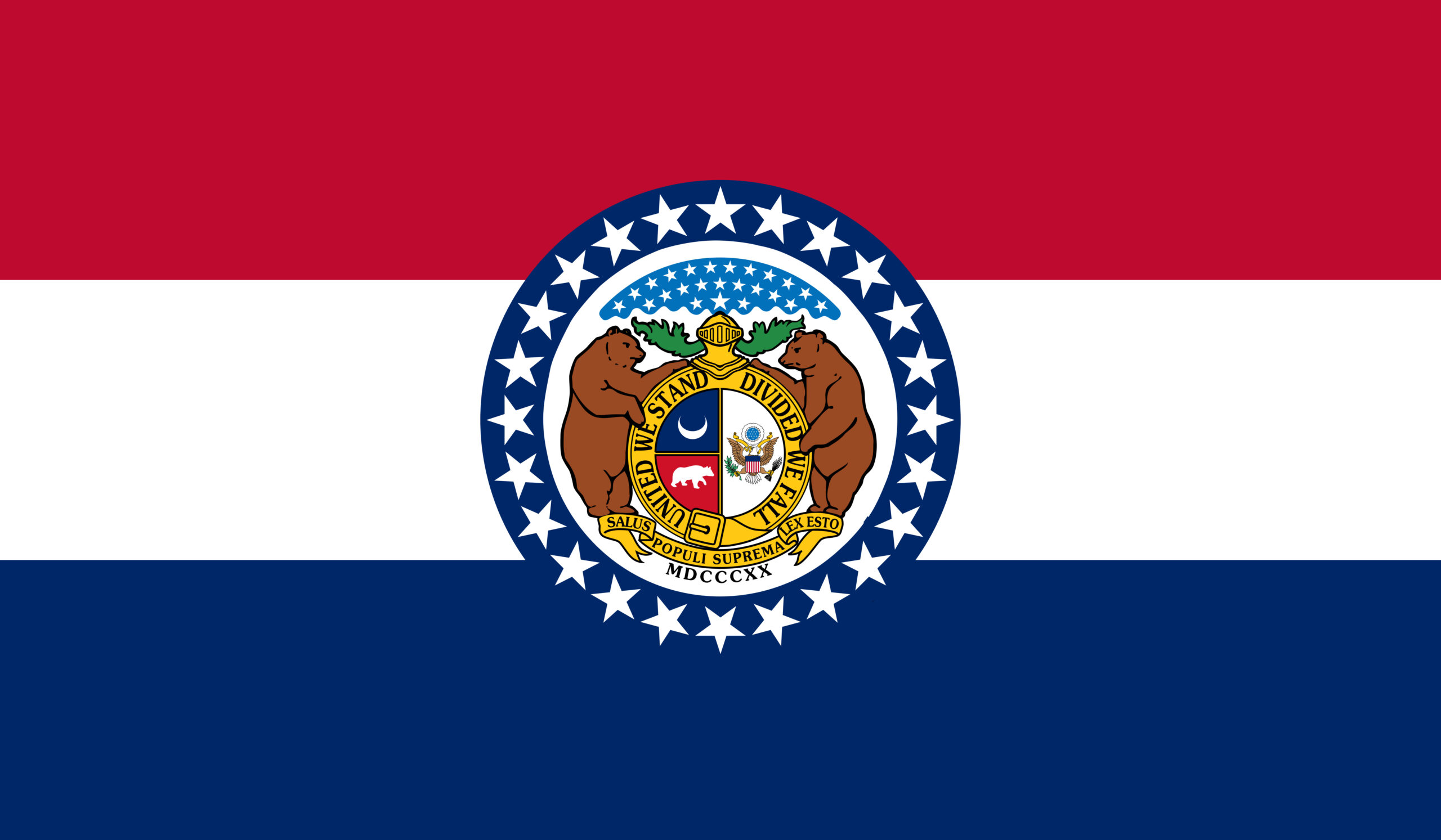
Ten years later the “Indian Removal Act” forced tens of thousands of Native people to vacate their ancestral lands and move to an “Indian Territory” in what is now Oklahoma. This “Trail of Tears,” as it has become known, passed through Missouri. Many of the indigenous inhabitants of the state had already been forced off their lands by 1839 when the State legislature made it illegal for Indians to reside within the state. So much for the protective power of the state’s “highest law.”
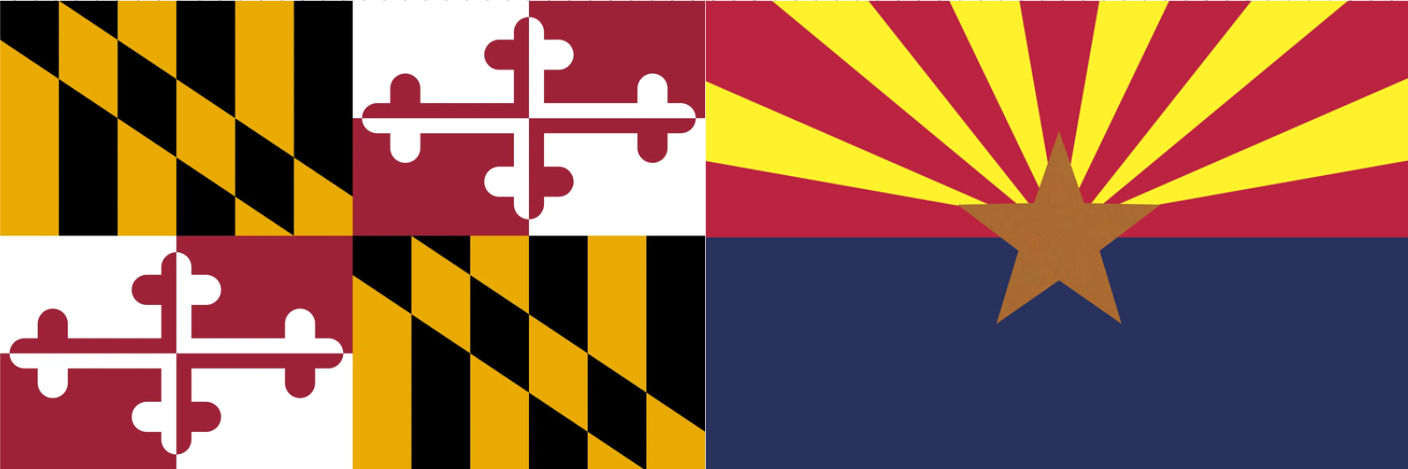
Most state flags do not have Latin mottoes on them, and not all have images of colonialism. Some don’t have any images at all. But even without images, the black/gold and red/white patterns of Maryland’s flag can still be considered a colonialist emblem. Those patterns reflect the Coat of Arms of the English Lord who administered the colony before the Revolutionary War. Similarly, the colors in the upper half of the Arizona flag are intended to imitate the Spanish flag of the “explorer” Coronado, whose sixteenth-century expedition into what is now Mexico included the first war between Europeans and Native Americans. In this way, colonialist histories can lurk even in the most abstract of emblems.
Celebrations of colonialism are lurking in so many flags because the very idea of a “state” with defined political boundaries — whether we are talking about the nations of the world or the subdivisions of the U.S. — is a colonial one. Latin mottoes and images of plows are just the symbols through which such states claim legitimacy. Every flag — even Minnesota’s new design — symbolizes a violent history through which land became property.
