When the Richest Man in the World Loves Classics

Elon Musk is (as of now) not only the richest man in the world but also, thanks to President Trump’s embrace of him, one of the most politically powerful. He also loves Greco-Roman antiquity. That love received increased attention when Musk’s allies defended his use of a Nazi salute at Trump’s inauguration by calling it a “Roman Salute,” a defense that makes his gesture just another example of his interest in ancient history and not an embrace of fascist politics. Pharos has already documented a notorious neo-Nazi making this same defense, and Sarah Bond and Stephanie Wong have recently challenged this latest attempt at sanitizing and normalizing the gesture. There’s nothing “Roman” about Musk’s salute, but he’s always used antiquity to promote the politics it represents. We don’t need to debate what the gesture “really” was or what it “really” means to see that Musk’s fascination with antiquity has always drawn on understandings of the past that are implicated in white nationalism.
A Nazi gesture is not incongruous with some of Musk’s previous statements and actions. After Musk restored many suspended Twitter accounts, including those of notorious neo-Nazis whom Pharos has documented, hate speech flooded the platform. Musk claimed to be working on it, while defending a racist rant by the author of the comic “Dilbert,” and amplifying an antisemitic conspiracy theory, leading major advertisers to boycott the platform. But, perhaps because someone so wealthy doesn’t need those advertisers’ support, he’s just kept posting.

And when it comes to politics, Musk puts his money where his mouth is. His spending in support of Donald Trump’s campaign makes him one of the largest donors in the history of American presidential politics. The candidate he helped elect is now targeting the LGBTQ community and immigrants. But a man with an imperialist fantasy of colonizing Mars isn’t content with promoting such policies in just one country. He’s expressed support for a notorious British activist with a deep history in fascist and Islamophobic politics and even campaigned for the German “Alternative for Germany” party, which many observers argue represents the modern evolution of past German nationalist, antisemitic, and xenophobic politics. It’s hard to measure the impact of these messages, but, whatever impression these made on his more than two-hundred million followers on X, his gesture at the inauguration should be seen as just the latest example of a familiar political perspective from the billionaire. Certainly that’s how white nationalists saw it.
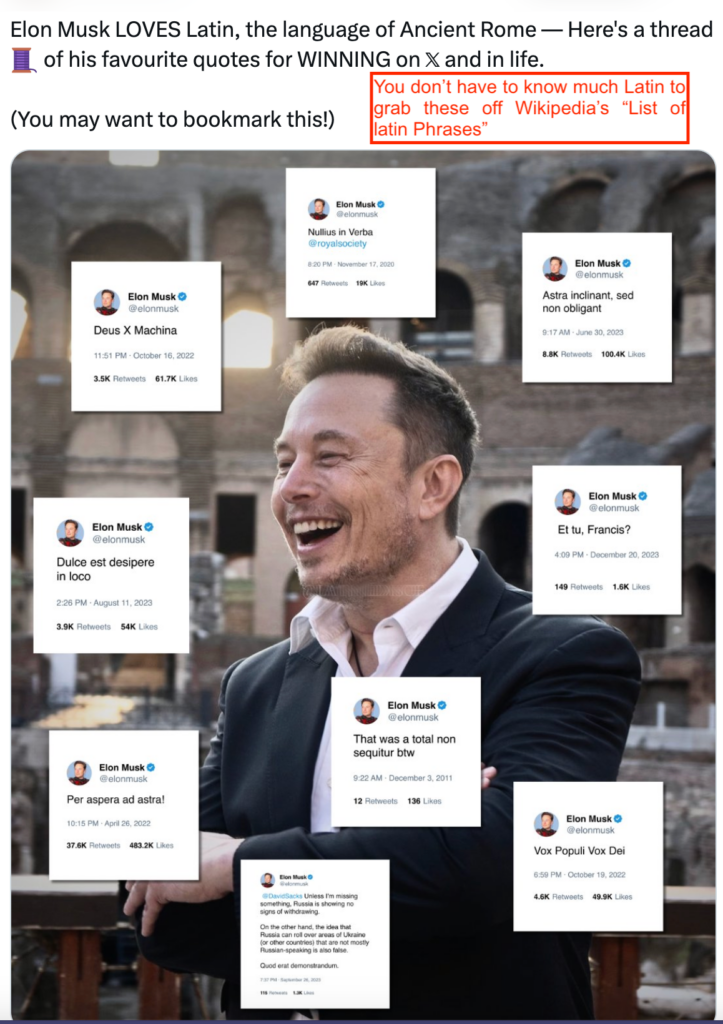
Musk is committed to using his wealth and viral popularity to influence politics in the U.S. and abroad, and Greco-Roman antiquity has always been one of his favorite rhetorical tools. Sure, he sometimes just seems like a fanboy, with his frequent use of Latin quotes, his images of himself in gladiatorial armor generated by AI as part of a feud with Mark Zuckerberg (another billionaire interested in Greco-Roman antiquity, especially authoritarian rulers), and his confused recommendation to his followers to read the Iliad in a post featuring an image of a translation of the Odyssey. But more often than not, Musk’s posts about ancient Greece and Rome use the prestige of Greco-Roman antiquity to claim legitimacy for his political positions, however hateful or anti-democratic.

One of white nationalists’ primary rhetorical moves is to claim that because an ancient author wrote something, it must be true. Musk has stoked anti-government sentiment with a quotation from the Roman historian Tacitus’s Annales — “the more corrupt the state, the more numerous the laws” — that Tacitus only intended to describe a specific moment in Roman history, not as a truth for all times and places. What Tacitus says is “And now [following the restoration of power to the Tribunes] bills began to pass, not only of national but of purely individual application, and when the state was most corrupt, laws were most abundant.” The memified version of this quote ignores the context in which it appeared. And the “corrupt” politicians this quote describes are those who provided one of the few checks on the power of wealthy elites in Rome. No wonder the wealthiest man in the world finds this quote attractive.
Musk’s posts about antiquity do not overtly engage in hate speech but they tread the same ideological paths as fascism
Musk’s posts about Greco-Roman antiquity also suggests he finds political violence attract. For example, he has invoked the Roman dictator Sulla as a model for cleansing a state of alleged foreign influence. It’s true Sulla played a pivotal role in a war against the African king Jugurtha who had bribed Roman officials, but Musk does not mention that Sulla went on to offer rewards for the assassinations of hundreds of his most powerful political opponents in a brutal purge of the Roman senatorial and equestrian classes. And he uses Classical symbols as part of his (disingenuous) argument that his platform supports “free speech” even as hate speech and disinformation proliferate there. He has described X as the “voice of the people,” using the Latin phrase vox populi (not for the first time) to impart grandeur and dignity to the claim. He posted a meme showing an image from the crypto-fascist film 300 that casts the Spartan general Leonidas as “free speech” being protected by his shield, which represents X in the meme. These posts do not overtly engage in hate speech themselves, but they tread the same ideological paths as fascism, by demonizing the contemporary world as corrupt, fetishizing political violence, and repurposing popular political ideals in support of oppressive ends.
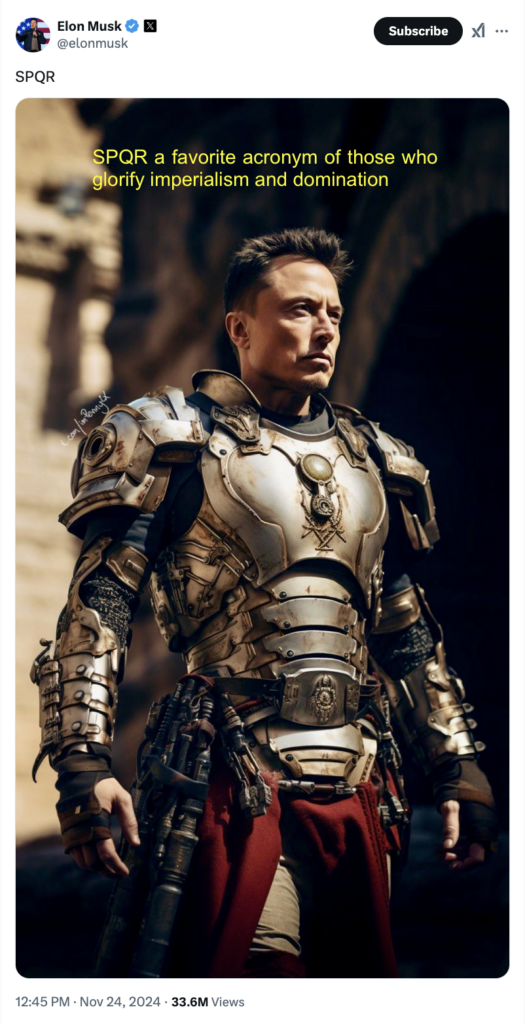
Others of Musk’s posts reveal this investment more obviously, for those attuned to the ways that Greco-Roman antiquity has traditionally been used to promote violence and oppression. This goes beyond his use of the Latin-ish name “Kekius Maximus” to promote a new cryptocurrency, with its embrace of Pepe the Frog, the most familiar symbol of the white nationalist “Alt Right” and its successor “Groypers.” An AI-generated image of Musk in Roman armor is more than cosplay when it is posted with “SPQR.” This acronym, which stands for “The Senate and People of Rome,” is commonly used to represent the Roman Empire as an admirable, civilizing force in history, but this is especially true among white nationalists who positively admire how that empire was also an engine of genoice and enslavement because such violence, the believe, is integral to the establishment of racially pure ethnostates.
Musk’s deployment of antiquity is just a microcosm of his overall rhetorical strategy
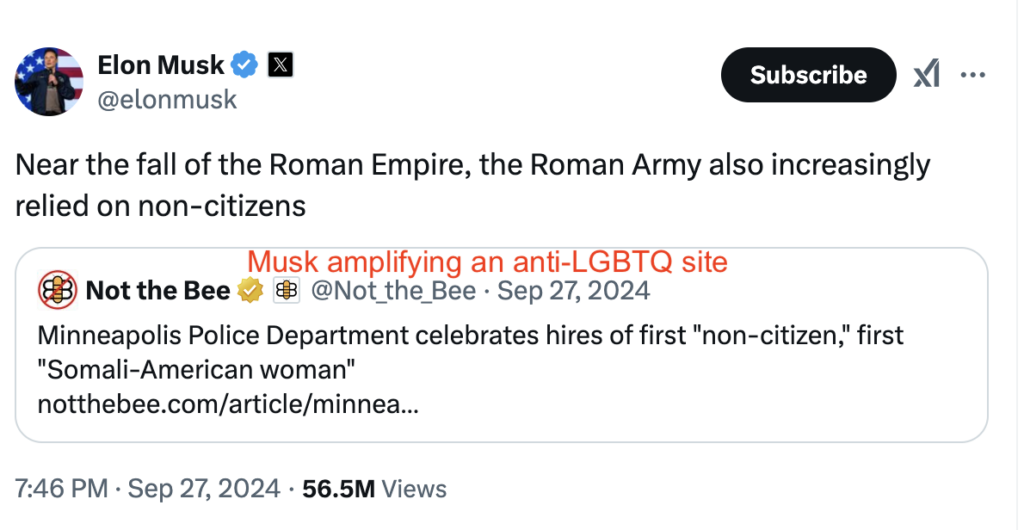
Indeed, Musk seems well versed in the traditions of Roman historiography by which fear-mongers use simplistic comparisons to Rome to argue that whatever scapegoat preoccupies them really does threaten the survival of the modern nation. Pharos has documented claims that the example of Rome proves that feminism, immigrants, homosexuality, and multiculturalism are harmful. We can add Musk’s posts to these. Responding to an anti-LGBTQ’s site’s coverage of the swearing-in of a lawful permanent resident to the Minneapolis Police Force, Musk wrote that “near the fall of the Roman Empire, the Roman Army also increasingly relied on non-citizens,” seeming to imply that such an inclusion will compromise the rule of law and public safety, but apparently forgetting that non-citizen socii had been instrumental in the Roman Army throughout its history, including its most successful periods.
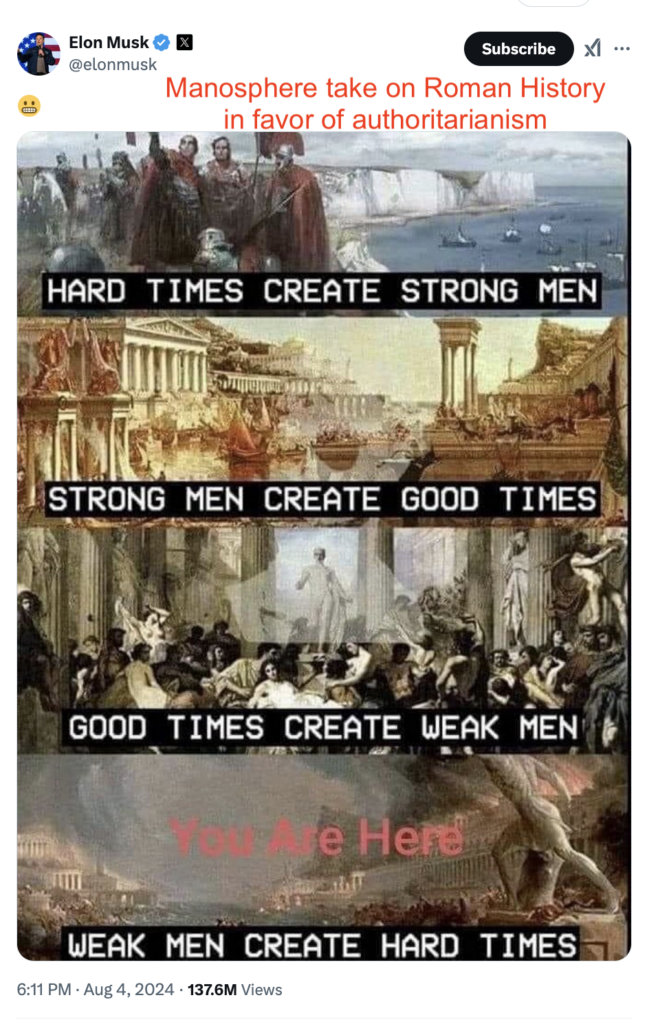
Musk’s preoccupation with decline was also on display when he posted a meme that illustrated the following narrative with neoclassical paintings of Rome: “Hard times create strong men. Strong men create good times. Good times create weak men. Weak men create hard times.” Such claims of universal cultural progressions fundamental to the fascist promise of regeneration amid the supposed decadence of contemporary times. “You are here,” the meme notes in the last panel, which shows Thomas Cole’s “Destruction.” It’s a logic that both makes the toxic linking of masculinity with strength and violence a precondition of prosperity and also makes the elevation of such “strong men” to positions of power seem desirable and inevitable. An appropriate meme for a man with the ambitions Musk seems to have.
In the end, for all the claims about Musk’s alleged genius, his understanding of antiquity is pretty superficial: memes (already a significant source of hateful takes on antiquity), quotes taken out of context, AI generated images. But when you have a platform as big as he does, and the money to make yourself heard, that superficial version of history drowns out any other version of the past. In this way his deployment of antiquity is just a microcosm of his overall rhetorical strategy of spreading disinformation for political ends: “flood the zone with shit,” as Musk critic and fellow admirer of Greco-Roman antiquity Steve Bannon put it. It works, and there’s not much individual people can do to stop him from doing it. But we can stop listening and focus on what we can do to mitigate the harm that men like Musk and his allies are going to attempt to enact.
We have annotated screenshots of Musk’s posts so that anyone reposting them from this article must also repost Pharos’s critical perspective on them.
Musk posts about Greco-Roman antiquity so frequently that it is difficult to keep up with it all. If you know of any examples we haven’t covered above, or if he posts about it in the future (he will), we’d love to hear from you: pharosclassics@vassar.edu, or tag Pharos director @curtisdozier on Bluesky.
